After a pretty rubbish day yesterday, when I couldn't find any birds anywhere, today was a significant improvement.
Just to put yesterday morning into perspective: I arrived at the Nanaimo River estuary to find top local birder Steve Baillie tapping determinedly into his Blackberry. He informed me that I'd missed a male lazuli bunting by minutes! Nice find, Steve!
Despite an hour searching the area, I failed to relocate it - or anything else of interest. Ralph Hocken arrived, and after a while I decided to go and check the mudflats, in case any shorebirds were out there taking advantage of the low tide. Ralph came along and we soon discovered that the food-rich estuary was being spectacularly ignored by any long-billed transients. A quick, desperate, stop at Holden Creek was equally bleak.
Ever optimistic, I returned to the estuary in search of a certain bunting late afternoon, to no avail. Though, a pair of warbling vireo in the oak provided a pleasant distraction.
So, I decided to take Sunday a lot more easily. Jenny and I took a leisurely stroll to Hemer Park, before the rain commenced. Highlights here included: chipping sparrows, western tanager, black-headed grosbeak & gadwall.
Later, I headed down to Holden Creek and gave it a thorough once-over. A single pectoral sandpiper was on the 'back pool' - see pic. Other than that, just the usual spotted sandpipers, killdeer, red-tailed hawk, yellow warbler etc were noted. An osprey flew over.
I drove over to the estuary and decided to have a careful creep around the bushes near the big oak - just in case...
After rousing a few white-crowned sparrows, my pishing was met with a distinctive 'tick' call, considerably less metallic sounding that the w.c. sparrows'. I continued to pish and BINGO! Up popped the lazuli bunting. It sat out in the open for a short while, allowing a snap or two, before diving into the brambles. Thrilled (yes, it was a world tick!), I decided to leave it alone and have a quick check from the platform.
The rain was coming in now, and other than 3 green-winged teal on the river, there was little to get excited about. I headed back to the car and was amazed to see the lazuli bunting feeding on the footpath between the oak and the car park! It flew up and landed on the wire fence, posing nicely before flying off towards the fields.
Sunday, 30 May 2010
Friday, 28 May 2010
Teal for Two
I made my way down to Holden Creek this evening, just as the tide was rising. Other than 7 spotted sandpiper, there were no shorebirds to be seen until I spotted a greater yellowlegs way out on the back pool.
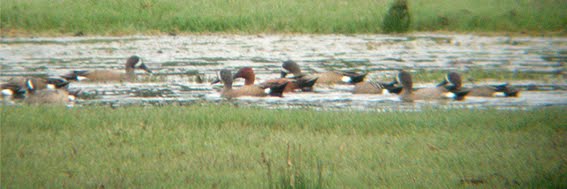
The a flock of 17 teal flew in and landed on the same pool - they all appeared to be blue-winged. Scoping through, there were 15 drakes and just 1 duck, plus a drake cinnamon teal that I hadn't picked up in flight(!). Nice sight.
Otherwise it was all quiet, with the exception of a peregrine that came through briefly scattering the starlings.
Labels:
blue-winged teal,
cinnamon teal,
Holden Creek,
perergrine
Thursday, 27 May 2010
Oriole surprise
A quick visit to Holden Creek after work this evening was pretty unproductive - the tide was rolling in but nothing was being flushed out of any channels, boggy nooks or, indeed, muddy crannies. At least 5 spotted sandpiper were seen, with some renewed courtship taking place.
I decided to leg it round to Raines Road, to check the estuary from there. I arrived to find the river rising significantly, and the marsh flooding. I scanned around but other than two very distant flying peeps, there were no shorebirds of note. The pair of spotted sandpiper were moving noisily around the place and a pair of killdeer were also present.
Paddling around with the few mallard still in the area, were 9 gadwall and a lingering drake American wigeon.
A bald eagle was taking advantage of the high water levels and grabbing at something from a flooded grassy area by the river (pic).
A surprise came in the form of 3 cedar waxwings that were flycatching from a hawthorn near the viewing platform.
Just before I left I thought I'd have one last look out by the 'bluebird posts'. Glad I did. I spotted a distant, medium-sized passerine flying into a small bush out on the flooded marsh. Through bins at considerable range it looked greenish. Huh?
Keeping my eye on the bush, I erected my tripod and got onto it with my 'scope, just as it flew! I could see yellow on its head and undertail... I found it again as it clambered around in a small crabapple. Oriole! White wing bars, brownish upperparts, pale belly - female Bullock's oriole. Nice one. I watched it distantly for a few seconds as it moved around from small bush to small bush, and I even managed a quick, crap, shot (pic) before it took to the air and flew high in the direction of Holden Creek.
Wednesday, 26 May 2010
Water, water everywhere...
Blimey, the water levels were really high at Holden Creek this evening. As I was there the tide continued to bring water in until it resembled not so much as creek, as a lake.
Anyhoo - I expect that a couple of pairs of spotted sandpiper will have lost eggs. I guess it's early enough for them to re-lay, if that is the case.
At least 2 pairs seem to have established their nests out of harms reach, as regards flooding.
There weren't any other waders in evidence - just goes to show that frequent coverage is essential as regards spring passage birds. The dowitchers, semi-palmated plovers and pectoral sandpipers, that I've seen, have all been one-dayers. Makes one wonder what was there, on the days no-one checked! That's the kind of thinking that can keep me awake at night!
A female purple martin briefly joined the other swallow species to make a full suite of hirundines and as I was leaving a handful of black swifts came in with a single Vaux's among them. As I watched them, the sky practically filled with swifts until there were approximately 80 blacks swirling around. I'd always just thought of black swifts as being pretty much the nearctic version of European common swift, but the more I see of them the more apparent it is that they are strikingly different in so many ways.
Labels:
black swift,
Holden Creek,
vaux's swift
Tuesday, 25 May 2010
Pec' 'pipers prove positive
The tide was encouragingly high this evening when I arrived at Holden Creek but my thoughts of hordes of refuge seeking shorebirds seemed dashed.
A check along the creek revealed the usual spotted sandpipers.
A combination of recent rain, and high tidal levels, meant that the marsh was at least wet and several of the flashes contained enough water to, hopefully, attract any passing waders over the next few days. Ever the optimist...
Scanning out across the marsh I spotted a large shorebird feeding on the very furthest pool. Great. 'Scoping it, it was as expected, a greater yellowlegs. However, some smaller waders were nearby and I just couldn't get enough on them as they weaved around in the grassy edges. Unfortunately, it wasn't only distance that was against me but the sun had decided to show up for the first time all day, and was liberally blasting down and creating lovely silhouettes.
I walked out onto the marsh and eventually positioned myself at the base of one of the pilings for the electricity poles.
Through bins, at this far better range, their identity was pretty well confirmed but a 'scoping made it certain. 4 pectoral sandpipers (2 of which are pictured, with customary lack of skill, left).
Not exactly what I'd have liked them to be, but beggars, as they say, can't be choosers and it was great to watch them feeding alongside the yellowlegs. I guess they're not particularly common birds on Vancouver Island in the spring?
Otherwise, 3 killdeer, 2 ospreys, common yellowthroat and the usual stuff kept me busy.
Labels:
birds,
Holden Creek,
osprey,
pectoral sandpiper,
Vancouver island
Monday, 24 May 2010
One good tern, etc
An early evening wander around the Nanaimo River estuary was timed pretty nicely to coincide with the exodus of the last of the day's dog walkers & saltmarsh wanderers.
Naturally, it was reasonably quiet bird-wise (UK readers note: today was a Bank Holiday, Victoria Day. In honour of the Queen of the same name. Pity these Canadians don't have a day off for every dead British monarch, I'd have a lot more time on my hands for birding...) athough an osprey fishing over the sea made for a pleasant sight.
A spotted sandpiper was on the river and I could hear a greater yellowlegs calling from out in the creeks. As I scanned over the tide edge I noticed a pair of Caspian tern fishing around the estuary mouth. Nice.
Crossbills were still in evidence, with a small group feeding by the pool edge.
A quick check of Holden Creek was, unfortunately, pretty unremarkable. Just a handful of spotted sands were on the creek.
Mystery revealed...
Okey dokey. Mystery bird time. Not as straightfoward as I assumed it would be.
Nobody went for peregrine. Odd, given a majority vote for a falcon sp.
11% chose short-eared owl. I think we can quickly discount this species on the upper wing pattern and colouration alone. The overall wing shape doesn't look right for an owl, and the tail seems way to long.
19% of those taking part went for sharp-shinned hawk. Structurally, more convincing than SE owl, I must say, and those wings do look a little accipiter-ish even if the overall jizz seems a bit off. But what about that reddish upperpart colouration? I'd be surprised to see that on a sharpie. Looking at the tail, I'd suggest also that the barring is too 'fine' for this species.
So, that leaves us with a clear winner: American kestrel, which attracted the lion's share with a whopping 69% of the participants' votes. And indeed they're all correct. This was a female kestrel photographed on the Nanaimo River estuary by Ralph Hocken (thanks for the pics Ralph). Same bird shown here.
Thanks, as always for taking part and please feel free to comment on any pics, or my wishy-washy descriptions.
Sunday, 23 May 2010
Tickety-boo!
Had a quick late morning scan over at Quennell Lake today. Couldn't see the ruddy duck, but there were a few boats on the water, so maybe it had moved to a quieter part of the lake.
A Cooper's hawk caused some consternation amongst the swallows and Brewer's blackbirds, who mobbed it relentlessly until it scarpered. At the southern end of the lake, 6 purple martin were feeding among the commoner hirundines.
What was presumably a cedar waxwing flew by, identified as such only by the sight of yellow tail tips and absence of white in the wing.
Later, Jenny and I had a walk along the Cable Bay Trail. It was pretty birdy, with lots of stuff calling and singing - very frustrating for a Brit birder such as me with a lot of aural learning to do! Of the things I did recognise, or see, were black-headed grosbeak, Swainson's thrush, Wilson's warbler, western tanager, brown creeper, hairy woodpecker and pileated woodpecker and peregrine.
Best of all however was the Cassin's vireo that kindly responded well to my pishing. My mate Adrian had found the nest site of a pair here last week, and having thoroughly embedded the song into my head picked up on it immediately as it sang from up in the canopy. I got great views of the male as it came down to investigate the curious psshhh noises below. Now, as it hard as it may seem, this was actually a world tick for me, and certainly the commonest Vancouver Island bird I'd not seen. Yippee!
We also came across a fab little masked shrew, which allowed us close approach as it scoffed an unfortunate beetle. Jenny's undoubted highlight of the walk...
Late afternoon, spurred on by my first tick in 5 months, I decided to go the airport and see if I could add Vesper sparrow to my BC list. I eventually found a single bird (pictured), and as I looked at it I had the horrible feeling that I was looking at a vesper sparrow for the very first time. Somehow or other, I'd got it into my head that I'd seen this species before, but after I got home and checked through some notebooks it would appear that I had gained another tick! How the hell did that happen? Idiot.
Labels:
Cable Bay Trail,
Cassin's vireo,
Quennell Lake,
vesper sparrow
Saturday, 22 May 2010
Ruddy heck, a noteworthy duck!
Didn't really get any birding in today until early evening when an, ill-timed, visit to Holden Creek coincided with a spell of persistent drizzle. Nice.
Not too much to report, as a result. A single least sandpiper was on the creek, and at least 5 spotted sandpipers were chasing each other around. A couple of Wilson's warblers were feeding in the gorse.
As it started to clear, I headed to Quennell Lake to see if I could find anything interesting there. Again, a single least sandpiper was on the muddy ex-lake, as were a couple of killdeer with 1 chick.
A lone drake green-winged teal was with 5 mallard at the back and a drake wood duck was on the actual lake (ie the one with water). Tones of hirundines were feeding around the place - northern rough-winged, barn, tree, violet-green and cliff were all present in good numbers. I couldn't resist snapping a couple as they sat on the wires in the low sunlight. (For those not familiar with American swallows, the pic shows from left to right, violet-green, cliff & tree). A Vaux's swift came through and fed briefly before heading off north.
Something of a surprise was a female ruddy duck on the lake. I think they're pretty scarce 'round these parts... I think this is another species I last saw on vancouver Island back in the early 90s.
Glad to see such a good response the most recent mystery bird... answer, and a new one, coming soon!
Labels:
birding,
Holden Creek,
Quennell Lake,
Vancouver island
Friday, 21 May 2010
Black Friday
After seeing our guests off at 6.45am, I headed off to the Nanaimo River estuary for a spot of pre-work birding, despite the downpour.
As soon as I arrived at the parking area it stopped raining - wow, what luck!
The area around the big oak was jumping with yellow warblers, plus a couple of Wilson's. It became apparent however, that little had been dumped in the rain and my hopes of a kingbird, redstart, or such treasure, drained away along with the rain water.
As I was leaving however, a handful of black swifts appeared overhead and as I watched them, yet more pass through - I estimated a total of around 70 birds. They continued to feed over the estuary and drifted toward Holden Creek.
After work, I went to the aforementioned creek but it was just as quiet as yesterday, really. On the plus side, the spotted sandpiper numbers had crept up to an impressive 8 birds.
Thursday, 20 May 2010
Devil birds over Nanaimo
The undisputed highlight of my day was noticing some dark scythes heading my way, as I glanced out of the office window just before 11am today. A small flock of approximately 12 black swifts started feeding around the building, having come in just ahead of a gloomy, dark cloud. They continued to whizz around for about 40 minutes before spiralling away. Excellent stuff - another bird I hadn't seen for quite a few years!
The only other ave of notice was the male Anna's hummer down at the Mafeo Sutton Park at lunchtime.
In the evening, Adrian joined me for his final Canadian birding jaunt down to Holden Creek, before heading back to Blighty in the morning. It was pretty unremarkable - 3 spotted sandpiper were the only waders seen. Otherwise, it was hirundines, cowbirds and goldfinches... and Mike Ashbee.
Labels:
bird,
birding,
black swift,
Nanaimo
Subscribe to:
Posts (Atom)