After walking Jenny to work early this afternoon, I strolled around to Ogden Point, enjoing the glorious sunshine.
There were a handful of black turnstone in the harbour area, and a 2nd winter ring-billed gull was on the rusty metal float just by the pilot boat dock.
I carried on along the waterfront to Clover Point where I had the pleasure of bumping into top BC birder and all-round nice chap, Mike Force. I had met Mike at Rich and Lori Mooney's wedding and we had a good chat about various things, though frankly, it was mostly birds. He'd been lured west from his Okanagan home by the northern wheatear found near Vancouver Airport mid-week and was spending a few days in the area. Seems odd anyone would twitch a northern wheatear, but then I suppose most North American birders would be astonished by the reaction the discovery of a savannah sparrow would get in the UK... swings and roundabouts, and all that.
Anyhoo, there wasn't much going on at Clover Point, unsurprisingly. Highlights included 4 black turnstone, 8 Heermann's gulls and, as it happens, a savannah sparrow.
Late afternoon I headed out to Oak Bay Marina. The big yellow rock was, as usual, the hotspot and I spent a good hour sifting through the birds. A rather irritating heat haze didn't help too much but nonetheless, I was able to count 84 black-bellied plover, 8 black turnstone, 3 dowitchers, a surfbird and a wandering tattler. The latter had me going for ages. I just couldn't quite get enough on it for some time, and was conflicted between tattler and surfbird (bill length just wasn't clearly discernible), until it helpfully stretched and proved itself to have plain wings and rump.
Just south of the harbour, there were 5 greater yellowlegs roosting on their favoured rock, alongside 3 black oystercatchers and 7 killdeer. 3 American wigeon were my first of the autumn. A single, very confiding, least sandpiper was feeding on the beach, so I took a pic. As you can see.
Showing posts with label least sandpiper. Show all posts
Saturday, 3 September 2011
Saturday, 20 August 2011
Panama Flats Birds and Mysteries Revealed
![]() |
| Least & western sandpipers |
Least sandpiper were the most numerous with 37 birds present, while just 10 western sandpipers were seen. A single greater yellowlegs continues to hang on in, as does a spotted sandpiper. The latter was in the creek on the eastern edge of the site. A noisy quartet of purple martins came in for a while, feeding over the dried out pools, before heading off west.
In the lush vegetation near the creek there were a few passerines busily feeding, and a Lincoln's sparrow was trailing along with a flock of bushtits.
Mysteries Revealed
OK - I got a bit behind with these... apologies to anyone who might be desperate for the answers!
We'll start off with the last one. As 64% of voters all went with olive-sided flycatcher, I shall reveal that of course, that's what it was. I thought a few more might be tempted to go for other species, thanks to the unusual posture shown in this pic, but I really should know better than to underestimate you all!
Briefly, the other choices were gray catbird (11%) - this can be eliminated as the undertail coverts are clearly visible and lack the obvious rufous colour that would be visible. Similarly, catbird's black cap would show, and the overall colour of our bird is too subtle, catbirds are a striking slate grey.
Northern mockingbird garnered 23% of votes - I was expecting more to be honest. But, again the overall colour just isn't right, our bird is too brown and lacks any greyness. A mockingbird would have appreciatively shorter wings too, and a strikingly longer tail, among other things.
All voters ignored western tanager and eastern phoebe, and quite right too, as it looks nothing like either.
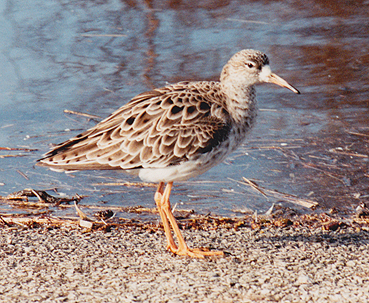
The previous mystery bird was clearly a wader (or shorebird, as is the preferred term in North America).
Again, one species took the lion's share of votes. Ruff attracted a whopping great 75% of thumbs' up.
Upland sandpiper fooled just one voter (actually, that was me trying to throw you off the scent...), pectoral sandpiper seemed like a fair bet for 21% of you while no-one was inclined toward buff-breast.
So, was it a pec? What about leg colour? Our bird has orange legs, not yellow ones as one would expect to see on a pectoral sandpiper. Slightly decurved bill, with an orange base certainly seems good, but doesn't that also fit adult ruff? And how about those bold white marks around the eye? And those clearly barred tertials? All things that point squarely to ruff. And so it was.
The new mystery bird should prove interesting - you might need to think outside of the box (to use a tired and frankly irritating phrase) with this one...
Friday, 29 July 2011
Dragonfly Delights
After a spot of dealing with various bits of bureaucracy, I found time late afternoon to make my way up to Panama Flats, just to see if there had been any interesting arrivals.
The two main pools still retain quite a bit of water, but it's disappearing fast.
For the meanwhile it does at least means that there's plenty of shallow water and muddy edges to entice passing waders, so the coming weeks could be really productive. Potentially.
The number of greater yellowlegs had increased slightly since my last visit, and there were 9 present, plus a single lesser yellowlegs. At least 7 spotted sandpiper were around, and just 6 least sandpiper.
I scoured every small vegetated pool and creek but still didn't manage to dig out a solitary sandpiper...
A group of 6, what sounded like, long-billed dowitchers were feeding together on one pool, while another pair of silent dowitchers were feeding on another.
There were around 20 killdeer in the more vegetated areas of the fields. Of course, a handful of mallard and 130 or so Canada geese were here too, as always.
There was lots of dragonfly action, with common whitetails especially numerous in some areas.
A few darners (California or blue-eyed) were also around, plus a couple of cardinal meadowhawks (pictured).
For those back in the UK, as you can see meadowhawks are sympetrum dragonflies - known in Britain as darters.
The two main pools still retain quite a bit of water, but it's disappearing fast.
For the meanwhile it does at least means that there's plenty of shallow water and muddy edges to entice passing waders, so the coming weeks could be really productive. Potentially.
The number of greater yellowlegs had increased slightly since my last visit, and there were 9 present, plus a single lesser yellowlegs. At least 7 spotted sandpiper were around, and just 6 least sandpiper.
I scoured every small vegetated pool and creek but still didn't manage to dig out a solitary sandpiper...
A group of 6, what sounded like, long-billed dowitchers were feeding together on one pool, while another pair of silent dowitchers were feeding on another.
There were around 20 killdeer in the more vegetated areas of the fields. Of course, a handful of mallard and 130 or so Canada geese were here too, as always.
There was lots of dragonfly action, with common whitetails especially numerous in some areas.
A few darners (California or blue-eyed) were also around, plus a couple of cardinal meadowhawks (pictured).
For those back in the UK, as you can see meadowhawks are sympetrum dragonflies - known in Britain as darters.
Wednesday, 13 July 2011
Evening Wader Watch
After finishing work today I managed a visit to Panama Flats, keen to see if there were any waders present.
Water levels were generally pretty low, bar the two main pools. There were good numbers of barn swallows feeding all over the place, plus a handful of violet-green and a couple of northern rough-winged swallows.
A group of 6 dowitchers were on the bank of the larger pool. When they flew, they called and they all sounded like long-billed.
Around the pools edges were 3 spotted sandpipers.
In the far south east corner, in a vegetated muddy area. there were approximately 230 peeps feeding. Scoping through them, the ratio of birds seemed to be about 60/40 western to least sandpipers.
After around 45 minutes of thorough scanning, I finally picked up a single semi-palmated sandpiper among them. Another spotted sandpiper was also here as were up to a dozen killdeer, including 2 very young, unfledged birds.
Walking back, I noticed a pair of greater yellowlegs (pictured) that had appeared from somewhere or other.
At one point a peregrine came through, spooking everything, before sitting up in a bare tree to the consternation of a local robin.
Water levels were generally pretty low, bar the two main pools. There were good numbers of barn swallows feeding all over the place, plus a handful of violet-green and a couple of northern rough-winged swallows.
A group of 6 dowitchers were on the bank of the larger pool. When they flew, they called and they all sounded like long-billed.
Around the pools edges were 3 spotted sandpipers.
In the far south east corner, in a vegetated muddy area. there were approximately 230 peeps feeding. Scoping through them, the ratio of birds seemed to be about 60/40 western to least sandpipers.
After around 45 minutes of thorough scanning, I finally picked up a single semi-palmated sandpiper among them. Another spotted sandpiper was also here as were up to a dozen killdeer, including 2 very young, unfledged birds.
Walking back, I noticed a pair of greater yellowlegs (pictured) that had appeared from somewhere or other.
At one point a peregrine came through, spooking everything, before sitting up in a bare tree to the consternation of a local robin.
Monday, 9 August 2010
Old Habits Die Hard
While checking through the few gulls down on the beach in Nanaimo at lunchtime, a pale flash of gull-like bird whizzed past my bins, all I got was black on the head and a bright orange bill - my obviously-still-not acclimatised bird-brain immediately thought 'Mediterranean gull', but obviously as soon as I found it and looked at it, it was clearly a Caspian tern. I must try and turn that 'autopilot' facility off.
On my way home this evening, I dropped by the Nanaimo River estuary at Raines Road, as it was the rising tide. Unfortunately, my work footwear (a sturdy pair of Doc Martens, rugged but not especially good for wading through water) prevented me from going out too far but I could see small groups of peeps flying around at the water's edge.
A cautious trudge, got me close to some waterlogged areas, and I found 3 lesser yellowlegs and several least sandpipers but nothing else. A slightly bulkier calidrid was among one flying group of leasts, presumably a western.
A single killdeer was calling from over at the river.
Not much else doing apart from zillions of crickets and grasshoppers, oh, and the customary hungry mosquitoes.
On my way home this evening, I dropped by the Nanaimo River estuary at Raines Road, as it was the rising tide. Unfortunately, my work footwear (a sturdy pair of Doc Martens, rugged but not especially good for wading through water) prevented me from going out too far but I could see small groups of peeps flying around at the water's edge.
A cautious trudge, got me close to some waterlogged areas, and I found 3 lesser yellowlegs and several least sandpipers but nothing else. A slightly bulkier calidrid was among one flying group of leasts, presumably a western.
A single killdeer was calling from over at the river.
Not much else doing apart from zillions of crickets and grasshoppers, oh, and the customary hungry mosquitoes.
Sunday, 8 August 2010
Mad Dogs and English(wo)men
My visit to Holden Creek was considerably drier this morning, thanks to the easing off of the rain. The pools on the marsh weren't quite so replenished as I'd hoped, and they were birdless, but for 4 least sandpipers.
A further 25 or so were in the Bog Of Eternal Stench, at the back of the marsh, but no other peeps were among these.
On the main creek that borders the farm fields things were slightly livelier with 5 lesser yellowlegs, 18 least sandpipers, 8 western sandpipers (pictured) and 1 spotted sandpiper.
3 more lesser yellowlegs flew over, but continued south and a flock of 6 killdeer took off from the marsh and headed in the same direction.
Later, Jenny and I took a walk down the Cable Bay Trail. This was the first time since spring that I didn't hear any Pacific-slope flycatchers in the forest - have all the breeders moved on? Similarly, I haven't seen any rufous hummers for a while... they stopped coming to my feeders a couple of weeks ago.
The woods were generally quiet bar the usual Pacific wrens, robins, chickadees, orange-crowned warblers and such. At the beach we noticed pigeon guillemot and pelagic cormorant, plus great blue heron, and belted kingfisher.
On our way back we were 'greeted' by an overly-enthusiastic golden retriever which seemed intent on jumping up and down on Jenny and covering her with muddy prints. I pulled the dog off and asked the owner to control his hound - Jen's not too comfortable around big dogs and anyone with a fraction of a brain cell would have been able to tell that she was visibly unnerved by fido's unwanted attention.
The owner, barely uttered the dog's name as a means of 'control', walked by us without acknowledging either my, reasonably polite, request or Jen's mud-covered presence, and casually walked on as his dogged trotted off after him. Needless to say a rather un-lady-like barrage of colourful descriptions, suggestions and sarcastic thanks, followed them deep into the forest.
Jenny's still fuming...
A further 25 or so were in the Bog Of Eternal Stench, at the back of the marsh, but no other peeps were among these.
On the main creek that borders the farm fields things were slightly livelier with 5 lesser yellowlegs, 18 least sandpipers, 8 western sandpipers (pictured) and 1 spotted sandpiper.
3 more lesser yellowlegs flew over, but continued south and a flock of 6 killdeer took off from the marsh and headed in the same direction.
Later, Jenny and I took a walk down the Cable Bay Trail. This was the first time since spring that I didn't hear any Pacific-slope flycatchers in the forest - have all the breeders moved on? Similarly, I haven't seen any rufous hummers for a while... they stopped coming to my feeders a couple of weeks ago.
The woods were generally quiet bar the usual Pacific wrens, robins, chickadees, orange-crowned warblers and such. At the beach we noticed pigeon guillemot and pelagic cormorant, plus great blue heron, and belted kingfisher.
On our way back we were 'greeted' by an overly-enthusiastic golden retriever which seemed intent on jumping up and down on Jenny and covering her with muddy prints. I pulled the dog off and asked the owner to control his hound - Jen's not too comfortable around big dogs and anyone with a fraction of a brain cell would have been able to tell that she was visibly unnerved by fido's unwanted attention.
The owner, barely uttered the dog's name as a means of 'control', walked by us without acknowledging either my, reasonably polite, request or Jen's mud-covered presence, and casually walked on as his dogged trotted off after him. Needless to say a rather un-lady-like barrage of colourful descriptions, suggestions and sarcastic thanks, followed them deep into the forest.
Jenny's still fuming...
Saturday, 7 August 2010
Precipitation anticipation deflation.
Stomping around the marshes, cold and wet in the persistent rain, reminded me of being back in England in August. Except there are fewer birds here.
My customary optimism was once again, unrewarded this morning at Holden Creek - I was confident that the overnight downpour would have dropped something interesting, and of course fill the dry pools with some much needed water to attract passing waders.
Sadly the birds, as is their wont, did what they wanted and ignored my 'expert' predictions. Bloody birds.
So, what was the result of my extremely thorough trawl around the boggy estuary today, other than getting an absolute soaking?
Somewhere in the region of 45 least sandpiper (juv pictured), 2 killdeer and 5 lesser yellowlegs.
The supporting cast was nothing to write home about - red-tailed hawks, bald eagle, barn swallows, orange-crowned warblers, bushtit, house finch, cowbird etc. The Canada goose flock has now tipped the 300 mark.
My customary optimism was once again, unrewarded this morning at Holden Creek - I was confident that the overnight downpour would have dropped something interesting, and of course fill the dry pools with some much needed water to attract passing waders.
Sadly the birds, as is their wont, did what they wanted and ignored my 'expert' predictions. Bloody birds.
So, what was the result of my extremely thorough trawl around the boggy estuary today, other than getting an absolute soaking?
Somewhere in the region of 45 least sandpiper (juv pictured), 2 killdeer and 5 lesser yellowlegs.
The supporting cast was nothing to write home about - red-tailed hawks, bald eagle, barn swallows, orange-crowned warblers, bushtit, house finch, cowbird etc. The Canada goose flock has now tipped the 300 mark.
Labels:
Holden Creek,
killdeer,
least sandpiper,
lesser yellowlegs
Saturday, 24 July 2010
Is There Life On Marsh?
Managed a visit to Holden Creek at low tide this morning.
Even though birds can be harder to locate at this site at low tide, at least there is access and no fear of getting cut off while out on the marsh!
As has been the case just lately, there were no waders along the creek. It seems that one is more likely to find good numbers of peeps on the muddy channels on the dropping tide, and especially when there are large numbers present in the area.
The lack of rain, and no particularly high tides, has left much of the marsh rather dry - and even the back pool, which often holds water and is consistent for attracting feeding shorebirds, was barely muddy.
Assuming I'd hit one of those blank days, I decided to check out all the potential areas, on the off-chance that I might find a bird or two.
As it happened, one smelly wet corner still had a bit of foul water in it, and consequently some birds to look at.
There were 12 least sandpiper, 3 semi-palmated sandpiper, 1 killdeer, 2 greater ( middle pic) & 2 lesser yellowlegs (top pic) and 2 pectoral sandpipers (bottom pic).
A few inspections of other areas of the marsh produced just 8 more leasts, 1 spotted sandpiper and 4 killdeer.
Even though birds can be harder to locate at this site at low tide, at least there is access and no fear of getting cut off while out on the marsh!
As has been the case just lately, there were no waders along the creek. It seems that one is more likely to find good numbers of peeps on the muddy channels on the dropping tide, and especially when there are large numbers present in the area.
The lack of rain, and no particularly high tides, has left much of the marsh rather dry - and even the back pool, which often holds water and is consistent for attracting feeding shorebirds, was barely muddy.
Assuming I'd hit one of those blank days, I decided to check out all the potential areas, on the off-chance that I might find a bird or two.
As it happened, one smelly wet corner still had a bit of foul water in it, and consequently some birds to look at.
There were 12 least sandpiper, 3 semi-palmated sandpiper, 1 killdeer, 2 greater ( middle pic) & 2 lesser yellowlegs (top pic) and 2 pectoral sandpipers (bottom pic).
A few inspections of other areas of the marsh produced just 8 more leasts, 1 spotted sandpiper and 4 killdeer.
Tuesday, 13 July 2010
Peeping at shorebirds
Popped down to Holden Creek for the incoming tide this evening. I counted 62 least sandpiper at Holden Creek but there were no other peeps present. Or curiously, any spotted sandpipers...
Out on the marsh was a single greater yellowlegs and a pair of killdeer.
A 'medium' wader, seen on flight only, and at considerable distance, was almost certainly a pectoral sandpiper based on size, shape and flight style. No feet were visible extending beyond the tail, and the bill wasn't especially long. Unfortunately the encroaching tide prevented me from going off to confirm its ID, after it landed out on the back of the marsh.
Just hope it wasn't anything more exciting, such as sharp-tailed sand... unless, of course it sticks around, in which case I hope that it is!.
Out on the marsh was a single greater yellowlegs and a pair of killdeer.
A 'medium' wader, seen on flight only, and at considerable distance, was almost certainly a pectoral sandpiper based on size, shape and flight style. No feet were visible extending beyond the tail, and the bill wasn't especially long. Unfortunately the encroaching tide prevented me from going off to confirm its ID, after it landed out on the back of the marsh.
Just hope it wasn't anything more exciting, such as sharp-tailed sand... unless, of course it sticks around, in which case I hope that it is!.
Monday, 5 July 2010
Monday wader watch
There were fewer small waders in the Holden Creek area when I visited this evening, and I counted no more than 14 least sandpiper.
There were still 3 western and 2 semi-palmated sandpipers present in the creek, and a pair of long-billed dowitchers were feeding in tandem with 2 greater yellowlegs out on the marsh flashes.
Friday, 2 July 2010
Holden Creek Peep Show
To celebrate Canada Day, I popped down to Holden Creek yesterday where the semi-palmated sandpiper was still hanging around with the least and western sandpipers.
Though, the numbers were significantly lower than yesterday, particularly regarding westerns which had gone down to about 8 birds, while leasts had increased to 19. 3 killdeer, and adult & 2 juvs, were on the creek. I counted more mosquito bites than birds...
A mink put in an appearance as it hunted along the creek.
Later I finally bagged a year-tick in the form of a common nighthawk which came low over us, while it was hawking the fields as we walked home from the Crow & Gate pub at 9.30ish. It was joined by a second bird, and they flopped overhead, showing well. Nice.
This evening (having doused myself in repellent) I went down to the creek after work. Once again, the number of waders had changed and there were around 70 least sandpipers feeding along the creek edge. 10 westerns were still present and a second semi-palmated sandpiper had arrived. Both birds are pictured above (the image on the left also shows a least sandpiper).
They are actually adults, as can be clearly seen now I bother to look properly... thanks to those who pointed this out!
And I only got bitten once, and there were bloody loads of mozzies about! Whoo-hoo!
And I couldn't resist getting some digi-scopey-film of one of the resident red-tailed hawks as it whined from one of the dead trees by the creek.
Though, the numbers were significantly lower than yesterday, particularly regarding westerns which had gone down to about 8 birds, while leasts had increased to 19. 3 killdeer, and adult & 2 juvs, were on the creek. I counted more mosquito bites than birds...
A mink put in an appearance as it hunted along the creek.
Later I finally bagged a year-tick in the form of a common nighthawk which came low over us, while it was hawking the fields as we walked home from the Crow & Gate pub at 9.30ish. It was joined by a second bird, and they flopped overhead, showing well. Nice.
This evening (having doused myself in repellent) I went down to the creek after work. Once again, the number of waders had changed and there were around 70 least sandpipers feeding along the creek edge. 10 westerns were still present and a second semi-palmated sandpiper had arrived. Both birds are pictured above (the image on the left also shows a least sandpiper).They are actually adults, as can be clearly seen now I bother to look properly... thanks to those who pointed this out!
And I only got bitten once, and there were bloody loads of mozzies about! Whoo-hoo!
And I couldn't resist getting some digi-scopey-film of one of the resident red-tailed hawks as it whined from one of the dead trees by the creek.
Wednesday, 30 June 2010
Autumn birding starts early
Visited Holden Creek again this evening and found that the place was more like late summer than the end of June.
A group of mixed waders were feeding along the creek, the majority being western sandpiper (34) plus least sandpiper (11) and a single bird which I believe was a semi-palmated sandpiper.
Now, I realise that they're quiet scarce on this part of Vancouver Island, so I'm happy to be corrected. I'm not terribly familiar with the species having rarely seen them in the past, and the thing that really bothers me about this individual is that it appears to be a juvenile, and it just seems too early for a young bird of that species to be down here at the end of June. As I say, please correct me if I'm mistaken. Unfortunately I wasn't able to see any webbing between the bird's toes, and taking shots with a hand-held camera up to my 'scope doesn't allow for quality images that might reveal that feature. All the exposed feet shots are blurred. The only thing I can't figure out is; if it isn't a semi-p - what is it? Am I missing something really obvious?
Anyway, here are some dodgy pics and a bit of footage.
A group of mixed waders were feeding along the creek, the majority being western sandpiper (34) plus least sandpiper (11) and a single bird which I believe was a semi-palmated sandpiper.
Now, I realise that they're quiet scarce on this part of Vancouver Island, so I'm happy to be corrected. I'm not terribly familiar with the species having rarely seen them in the past, and the thing that really bothers me about this individual is that it appears to be a juvenile, and it just seems too early for a young bird of that species to be down here at the end of June. As I say, please correct me if I'm mistaken. Unfortunately I wasn't able to see any webbing between the bird's toes, and taking shots with a hand-held camera up to my 'scope doesn't allow for quality images that might reveal that feature. All the exposed feet shots are blurred. The only thing I can't figure out is; if it isn't a semi-p - what is it? Am I missing something really obvious?
Anyway, here are some dodgy pics and a bit of footage.
Friday, 7 May 2010
Golden Holden
On the way home from work, Jenny and I stopped off at the Chase River Estuary park trail - a lovely wee spot, probably not too bad for birds at the right time of day/year...
Anyhoo, I dropped the missus off and legged it down to Holden Creek.
Quite an increase in the number of least sandpiper this evening with approx. 60 birds scattered around the marsh. The killdeer have 'lost' two of their chicks. To paraphrase Oscar Wilde, to lose one is unfortunate, to lose two, looks like carelessness...
A single greater yellowlegs and 2 spotted sandpiper were on the main creek.
Up to 8 American pipit were feeding on the marsh, and a couple showed on the muddy creek edge briefly (pic left). Got chance to have really good look at these spanking birds - absolutely gorgeous, far better than silly bluebirds or flashy warblers.
No sign of the semi-p plovers.
3 cackling geese and 4 white-fronted geese had dropped in and joined the 'resident' Canadas.
All the swallows were showing really well in the glorious golden evening sunlight, including the cliff swallows which were gathering mud again on the creek.
Popped by the boggy area on Gordon Road to have a listen for rails but there was nothing doing. A pair of common yellowthroat were nest building and the drake wood duck was there again - where's the female gone? In a hole somewhere nearby?
Oh, forgot to mention yesterday - had my first house wren of the spring down at the Nanaimo River Estuary.
Anyhoo, I dropped the missus off and legged it down to Holden Creek.
Quite an increase in the number of least sandpiper this evening with approx. 60 birds scattered around the marsh. The killdeer have 'lost' two of their chicks. To paraphrase Oscar Wilde, to lose one is unfortunate, to lose two, looks like carelessness...
A single greater yellowlegs and 2 spotted sandpiper were on the main creek.
Up to 8 American pipit were feeding on the marsh, and a couple showed on the muddy creek edge briefly (pic left). Got chance to have really good look at these spanking birds - absolutely gorgeous, far better than silly bluebirds or flashy warblers.
No sign of the semi-p plovers.
3 cackling geese and 4 white-fronted geese had dropped in and joined the 'resident' Canadas.
All the swallows were showing really well in the glorious golden evening sunlight, including the cliff swallows which were gathering mud again on the creek.
Popped by the boggy area on Gordon Road to have a listen for rails but there was nothing doing. A pair of common yellowthroat were nest building and the drake wood duck was there again - where's the female gone? In a hole somewhere nearby?
Oh, forgot to mention yesterday - had my first house wren of the spring down at the Nanaimo River Estuary.
Monday, 3 May 2010
Crappy Monday
You'd think that after all these years I'd know better than to go out when it's freezing, blowing a gale and chucking it down. Trouble is, some of the best birds I've ever seen, or found, have been in such grizzly conditions... what's a birder to do? Get a dousing, suffer an hour, or several, and trust that one day it'll all be worth it when that real crippler pops up in front of your bins.
So, from my opening paragraph, you, dear reader, can assume that I saw buggar all this evening. Correct.
I headed to Holden Creek, soggy shorebirds on my mind. Unfortunately, it was even worse than yesterday and just 13 least sandpiper (pictured) and the regular spotted sandpiper were present. It was utterly devoid of anything else, except a heron and a bunch of green-winged teal. Even the majority of the swallows were hiding. On the subject of swallows, I'm often taken aback by the difference in the colour of the underparts of North American erythrogaster barn swallows, compared to rustica ones - they're quite startling!
Still on the subject of swallows, I recently moved desks at work, and bagged a window - where I've been adding such stuff as bald eagle, turkey vulture, pigeon etc to my 'desk list'. Today I was rather delighted to see 8 purple martins heading right at me. Perked me up a bit.
So, from my opening paragraph, you, dear reader, can assume that I saw buggar all this evening. Correct.
I headed to Holden Creek, soggy shorebirds on my mind. Unfortunately, it was even worse than yesterday and just 13 least sandpiper (pictured) and the regular spotted sandpiper were present. It was utterly devoid of anything else, except a heron and a bunch of green-winged teal. Even the majority of the swallows were hiding. On the subject of swallows, I'm often taken aback by the difference in the colour of the underparts of North American erythrogaster barn swallows, compared to rustica ones - they're quite startling!
Still on the subject of swallows, I recently moved desks at work, and bagged a window - where I've been adding such stuff as bald eagle, turkey vulture, pigeon etc to my 'desk list'. Today I was rather delighted to see 8 purple martins heading right at me. Perked me up a bit.
Monday, 26 April 2010
Up a creek...
It was grey, cool and very drizzly when I got home, and so I elected on a short trip to Holden Creek for a bit of wader searching...
The tide was well up and the creeks were mud-less, so the majority of shorebirds were out on the flashes. I counted approximately:
120 least sandpiper
12 western sandpiper
1 dunlin
2 greater yellowlegs
1 spotted sandpiper (pic)
There were still around 30 green-winged teal present, but other than a single feeding American pipit and a fly through female northern harrier, there wasn't much else doing.
The tide was well up and the creeks were mud-less, so the majority of shorebirds were out on the flashes. I counted approximately:
120 least sandpiper
12 western sandpiper
1 dunlin
2 greater yellowlegs
1 spotted sandpiper (pic)
There were still around 30 green-winged teal present, but other than a single feeding American pipit and a fly through female northern harrier, there wasn't much else doing.
Labels:
birds,
Holden Creek,
least sandpiper,
pipit,
shorebirds,
waders
Sunday, 25 April 2010
Super calidrids are fab, but lighting is atrocious
A quick late afternoon visit to Holden Creek revealed yet more waders - one group on the channel was made up of 14 least sandpiper & 1 western sandpiper.
Two greater yellowlegs were nearby, and another feeding flock of c20 calidrids was out on the flashes - the low sun made them tricky to say the least, though a couple of dunlin were identifiable amongst them. Later they joined the others on the channel, and they all appeared to be westerns, apart from the two dunlin.
I think it's going to get rather interesting (and bloody frustrating!) over the coming weeks...
Two greater yellowlegs were nearby, and another feeding flock of c20 calidrids was out on the flashes - the low sun made them tricky to say the least, though a couple of dunlin were identifiable amongst them. Later they joined the others on the channel, and they all appeared to be westerns, apart from the two dunlin.
I think it's going to get rather interesting (and bloody frustrating!) over the coming weeks...
Friday, 23 April 2010
Nanaimo Delta blues
Had a wander around the estuary before heading into work this morning.
First bird of note was a Lincoln's sparrow near the big oak, but little else implied much in the way of fresh migrants until I found a female mountain bluebird in the fields.
A few yellow-rumped and orange-crowned warblers were working the hedge but it's hard to know whether they were new in - they weren't acting like newly arrived migrants.
An osprey passed over and did a bit of hovering out over the water and a peregrine zipped through.
Post-work, I returned to find even less. In fact, the only birds of note were a couple more Lincoln's sparrow, a merlin and an impressive flock of 136 common merganser on the river. 2 northern harrier were doing the rounds. Oh, and a MEGA on my way out - a collared dove was on the wires along Raines Road... yippee-doo. That's almost as good as pheasant.
Went to Holden Creek, just in case... The 12 white-fronted geese had multiplied and become 14. A single greater yellowlegs was feeding on the flashes and 4 least sandpiper were on the creek. One of the harriers came over, but it was pretty quiet otherwise.
Yesterday evening, I'd popped over to Quennell Lake, but it was fairly birdless: 1 pair shoveler, pair of wood duck, pair pied-billed grebe, ring-necked ducks, pintails, all the common swallows etc.
Holden Creek was quietish - a 'new' spotted sandpiper was present, as were Rich Mooney and Mike Ashbee. First time I've seen any other birders at Holden Creek!
First bird of note was a Lincoln's sparrow near the big oak, but little else implied much in the way of fresh migrants until I found a female mountain bluebird in the fields.
A few yellow-rumped and orange-crowned warblers were working the hedge but it's hard to know whether they were new in - they weren't acting like newly arrived migrants.
An osprey passed over and did a bit of hovering out over the water and a peregrine zipped through.
Post-work, I returned to find even less. In fact, the only birds of note were a couple more Lincoln's sparrow, a merlin and an impressive flock of 136 common merganser on the river. 2 northern harrier were doing the rounds. Oh, and a MEGA on my way out - a collared dove was on the wires along Raines Road... yippee-doo. That's almost as good as pheasant.
Went to Holden Creek, just in case... The 12 white-fronted geese had multiplied and become 14. A single greater yellowlegs was feeding on the flashes and 4 least sandpiper were on the creek. One of the harriers came over, but it was pretty quiet otherwise.
Yesterday evening, I'd popped over to Quennell Lake, but it was fairly birdless: 1 pair shoveler, pair of wood duck, pair pied-billed grebe, ring-necked ducks, pintails, all the common swallows etc.
Holden Creek was quietish - a 'new' spotted sandpiper was present, as were Rich Mooney and Mike Ashbee. First time I've seen any other birders at Holden Creek!
Monday, 19 April 2010
At long last, leasts!
Quick dash round the patch this evening - pretty quiet at the Nanaimo River estuary. The highlight was seeing the adult female and immature northern harrier hunting together over the marsh.
No swallows at all, or yellowlegs.
Headed round to Holden Creek, trying to beat the rain. A pair of greater yellowlegs were on the sluiced channel, and a further 3 were on the main creek. 3 killdeer were kicking around, and the nesting red-tailed hawks provided some entertainment as they saw off an interloper, of the same species. The dozen white-fronted geese were still grazing in the fields alongside their Canadian cousins.
Then, a little cloud of around 20 waders appeared, and once they eventually settled on the creek edge I could see that they were least sandpipers. At last, a bit of wader movement - hopefully this is the start of a spell of interesting passage...
No swallows at all, or yellowlegs.
Headed round to Holden Creek, trying to beat the rain. A pair of greater yellowlegs were on the sluiced channel, and a further 3 were on the main creek. 3 killdeer were kicking around, and the nesting red-tailed hawks provided some entertainment as they saw off an interloper, of the same species. The dozen white-fronted geese were still grazing in the fields alongside their Canadian cousins.
Then, a little cloud of around 20 waders appeared, and once they eventually settled on the creek edge I could see that they were least sandpipers. At last, a bit of wader movement - hopefully this is the start of a spell of interesting passage...
Subscribe to:
Posts (Atom)