Showing posts with label purple martin. Show all posts

Saturday, 20 August 2011

Panama Flats Birds and Mysteries Revealed

Least & western sandpipers
Found some time this afternoon to squeeze in a trawl around the Panama Flats area. The pools continue to resemble the moon's surface, cracked and mostly dry, although a couple of small muddy puddles still seem to be holding a few birds.
Least sandpiper were the most numerous with 37 birds present, while just 10 western sandpipers were seen. A single greater yellowlegs continues to hang on in, as does a spotted sandpiper. The latter was in the creek on the eastern edge of the site. A noisy quartet of purple martins came in for a while, feeding over the dried out pools, before heading off west.
In the lush vegetation near the creek there were a few passerines busily feeding, and a Lincoln's sparrow was trailing along with a flock of bushtits. 

Mysteries Revealed

OK - I got a bit behind with these... apologies to anyone who might be desperate for the answers!

We'll start off with the last one. As 64% of voters all went with olive-sided flycatcher, I shall reveal that of course, that's what it was. I thought a few more might be tempted to go for other species, thanks to the unusual posture shown in this pic, but I really should know better than to underestimate you all!
Briefly, the other choices were gray catbird (11%) - this can be eliminated as the undertail coverts are clearly visible and lack the obvious rufous colour that would be visible. Similarly, catbird's black cap would show, and the overall colour of our bird is too subtle, catbirds are a striking slate grey.

Northern mockingbird garnered 23% of votes - I was expecting more to be honest. But, again the overall colour just isn't right, our bird is too brown and lacks any greyness. A mockingbird would have appreciatively shorter wings too, and a strikingly longer tail, among other things.
All voters ignored western tanager and eastern phoebe, and quite right too, as it looks nothing like either.

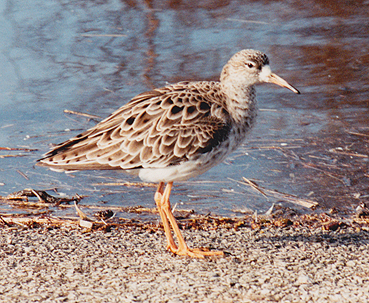
The previous mystery bird was clearly a wader (or shorebird, as is the preferred term in North America). 

Again, one species took the lion's share of votes. Ruff attracted a whopping great 75% of thumbs' up.
Upland sandpiper fooled just one voter (actually, that was me trying to throw you off the scent...), pectoral sandpiper seemed like a fair bet for 21% of you while no-one was inclined toward buff-breast.
So, was it a pec? What about leg colour? Our bird has orange legs, not yellow ones as one would expect to see on a pectoral sandpiper. Slightly decurved bill, with an orange base certainly seems good, but doesn't that also fit adult ruff? And how about those bold white marks around the eye? And those clearly barred tertials? All things that point squarely to ruff. And so it was.

The new mystery bird should prove interesting - you might need to think outside of the box (to use a tired and frankly irritating phrase) with this one... 

Wednesday, 3 August 2011

Not so solitary sandpiper...

It was a little cloudy overnight, and I woke up with thoughts of grounded migrant shorebirds. Not how everyone greets the day, admittedly, but as we birder's know, the urge to follow our instincts can be just as strong as our quarry's desire to move south at the breeding season draws to a close.

So, I headed to my new favourite Victoria birding spot; Panama Flats.
The northern pool looked pretty lively as I approached, and through my bins I could see plenty of avian activity. There were lesser yellowlegs all over the place, and I counted at least 13. By comparison, 11 greater yellowlegs were also present.
As I scanned through the least sandpipers and western sandpipers, a larger bird caught my eye.

An adult solitary sandpiper. Nice. The bird gave excellent views as it fed close to me, among other species. A few minutes later I picked up another, this time a juvenile, and after about half an hour the two birds were feeding together.
I counted 46 leasts and 17 western sandpipers in total, but due to the fact that they were constantly moving around the area, these counts were probably conservative under estimates.
Also present were a single semi-palmated sandpiper, 5 killdeer, 5 spotted sandpiper and 13 short-billed dowitchers. The dowitchers called clearly identifying themselves as short-billed - I suspect that when I saw 13 'long-billed'  a couple of days ago, my interpretation of their brief calls was faulty, to say the least!
Good numbers of barn swallow were around too, and among them I noticed at least 2 cliff swallows and a northern rough-winged swallow. A single purple martin also flew through, but carried on in a southerly direction.

Wednesday, 27 April 2011

Mid-Island Year-Tick Fest

Yesterday (Tuesday) Jenny had to go up to Nanaimo for much of the day for work purposes and so I decided to do the decent thing and keep her company. Of course this meant that I had to fill my day somehow, and I eventually chose to spend several hours on my old stomping grounds.
I started off at Holden Creek.
Although somewhat disappointing on the shorebird front with just a pair of least sandpiper and a couple of killdeer present, the wet fields had attracted a flock of c40 American pipit, and around 20 savannah sparrows. An American goldfinch was singing near the sluice, and a single northern rough-winged swallow came through, joined by barn and violet-green swallows.
An osprey circled over, and several turkey vultures cruised over the firs. A pair of greater white-fronted geese were among the Canadas in the fields.

I then headed along Gordon Road where I added common yellowthroat to my yearlist in the marshy area near Harmac Road. The ubiquitous red-winged blackbirds were here too, as was a showy, singing marsh wren.

Arriving at the Nanaimo River estuary, I noted a hefty and ominous cloud headed my way. Could be good, I thought... and indeed it was as a pair of purple martin preceded it and showed well above me for a few minutes.  Further hirundines came trickling through including my first cliff swallows of the year. No swifts materialised, but you can't have everything...
A female northern harrier was hunting over the marsh and a lone cackling goose was hanging around with 4 Canada geese on the river mouth. A handful of green-winged teal, American wigeon, pintail, bufflehead and common mergansers were also present. 
The tell-tale call of yellow-rumped warblers revealed a couple of males - one each myrtle and Audubon's. Since my last visit on 9th April, the number of savannah sparrows had gone through the roof and they were all over the place. White-crowned sparrows, having been absent all winter had replaced golden-crowneds with just on of the latter seen. A single Lincoln's sparrow was in the brambles by the big oak.

After grabbing some barely edible grub in Cedar, I went to see if anything was happening at Quennell Lake. Not much, as it happened. 12 northern shoveler, a few GW teal and lesser scaup were pretty much the best of the bunch. Tree, violet-green and barn swallows were all present in good numbers.

My next port of call was the airport where I hoped to see vesper sparrow. The first bird I saw as I stepped out of the car was however a lovely bright chipping sparrow, one of a pair present. I soon heard what I thought sounded right for a vesper singing and eventually located it sat in a distant bush.
It soon came a little closer but refused to stay still long enough to allow me to get a pic.
It then flew toward me and started feeding on the ground just about 6 feet away from where I was stood, scope and tripod at the ready. Way too close to focus, follow and photograph with my primitive set up... oh well, i got a really good look at it and even managed to read one of the numbers (2) on its metal ring! I probably could have seen more but for the fact that it was constantly moving, and favouring short grassy areas that obscured the ring somewhat.
It also sported darvic rings: orange over blue on the right, and a black over the ABA ring on the left. That should identify the individual - not sure who uses this info but if anyone reading this wishes to pass this on to the relevant person/people or let me know who to contact, I'd appreciate it.
I did get some nice sharp pics of it with its back to me, and the one here is the only one that shows its head. Not too sharp though... apologies.

After having my fill of this fine bird, I left it grubbing around in the dirt and headed off to Buttertubs Marsh before picking Jenny up. 
On my way, I noticed another osprey - adding sticks to a nest just by the highway south of College/5th. Noticing the time, I realised that my time at Buttertubs would be short and I barely had time to walk up to the platform. There were a handful of yellow-rumped warblers along the way, as well as downy woodpecker, Anna's hummingbird and marsh wrens blasting out from the rank vegetation. On the water there were just hooded mergansers and a pair of wigeon.

All in all a decent day's birding, and a reminder of why I love birding around estuaries.  

Monday, 3 May 2010

Crappy Monday

You'd think that after all these years I'd know better than to go out when it's freezing, blowing a gale and chucking it down. Trouble is, some of the best birds I've ever seen, or found, have been in such grizzly conditions... what's a birder to do? Get a dousing, suffer an hour, or several, and trust that one day it'll all be worth it when that real crippler pops up in front of your bins.

So, from my opening paragraph, you, dear reader, can assume that I saw buggar all this evening. Correct.
I headed to Holden Creek, soggy shorebirds on my mind. Unfortunately, it was even worse than yesterday and just 13 least sandpiper (pictured) and the regular spotted sandpiper were present. It was utterly devoid of anything else, except a heron and a bunch of green-winged teal. Even the majority of the swallows were hiding. On the subject of swallows, I'm often taken aback by the difference in the colour of the underparts of North American erythrogaster barn swallows, compared to rustica ones - they're quite startling!

Still on the subject of swallows, I recently moved desks at work, and bagged a window - where I've been adding such stuff as bald eagle, turkey vulture, pigeon etc to my 'desk list'. Today I was rather delighted to see 8 purple martins heading right at me. Perked me up a bit.          

Thursday, 29 April 2010

Spring limps on...

Another glorious morning with the wind from the wrong direction... Spent a pre-work hour wandering around the Nanaimo River estuary in search of, well, anything really.
Not too much doing, the usual white-crowned & savannah sparrows, yellow-rumped & orange-crowned warblers, towhees, red crossbills and such were in evidence but not much else.
A single greater yellowlegs flew over.
An American goldfinch was singing near the oak.

Stopped off at Holden Creek on my way home.
The tide was rising, but there was enough mud on the creek to interest a few least sandpipers and a spotted sandpiper. More 'peeps' (as our American birding chums, and certain UK twitchers insist on calling them) were out on the marsh, but the low sun behind them rendered them specifically unidentifiable, though those that got up and flew around calling were all leasts.
A greater yellowlegs was in attendance.
A pair of male brown-headed cowbirds were trying to woo a female (fem pictured), and engaging in some impressive moves. These are the first I've seen here, and are presumably new in.
Two males and a female purple martin joined the mass of barn, tree & violet-green swallows, from time to time, while smaller numbers of norther rough-winged and cliff swallows were also present. Another singing goldfinch was showing well and 12 white-fronted geese were back in the fields.
A female northern harrier was hunting over the fields too.

Tuesday, 27 April 2010

Cinnamon teal twosome save the day

Had a troll around the Nanaimo River estuary for an hour and a bit this morning from 6.30am.

Sadly I didn't find any major rarities, despite my undying optimism, but it was good to be out early. A mini-fall of yellow-rumped warblers had obviously taken place, with at least 30 birds along the long hedge. No other warblers among them sadly, other than a handful of orange-crowned.
A peregrine was sat out on a stranded tree-stump.
A pair of male purple martins were mucking around (pic) and the female northern harrier was hunting over the marsh. A singing American goldfinch was by the big oak.

After work, I bobbed along to Holden Creek. The water levels were extremely high.
A pair of cinnamon teal were a very pleasant surprise. The spotted sandpiper was still present, as was a single greater yellowlegs. It took me a while to locate any small waders, they were feeding in the small muddy puddles in the farm fields. Again, the majority that I could see were least sandpipers, plus a handful of westerns.
A lone cackling goose was among the Canadas.
The local killdeer have at least three hatched young.
Driving round to the estuary along Gordon Road, I had a pileated woodpecker fly over and a pair of wood duck were in the wet area.
The estuary was busy with people, but a few birds were still around... 3 belted kingfisher were flying around and all the common hirundines were seen. Otherwise it was pretty uneventful.

Saturday, 24 April 2010

Not so quiet on the Western front

I really need to spread my wings, so to speak, if I'm gonna catch up with any other stuff than that which frequents the estuary - at this rate, I could go all year without seeing a whole bunch of island birds...

Anyhoo, off to the Nanaimo River estuary I trailed this morning, and despite a good scour around, I was unable to discover anything too exciting.
Highlights included watching a merlin mobbing the adult female northern harrier, and seeing another 4 purple martins (2m 2f) joining the other common swallows. Incidentally, all common species of hirundine were present, tree, barn, violet-green, northern rough-winged and cliff.
A group of 6 least sandpiper flew low over, heading toward the Holden Creek area.
8 white-fronted geese were seen flying back and forth a couple of times.
The mighty cock pheasant was singing his delightful song from the fields.

A check-in at Holden Creek was next, and things looked a bit bleak. A lone greater yellowlegs was still on the channel as were a pair of copulating killdeer. Then I noticed a small calidrid on the muddy edges of the creek. It was a lone western sandpiper - my first at this site, and hopefully the vanguard of more to come.

Before I went to gather Jenny from the world of Elvis costuming, I popped into Buttertubs Marsh for a quick peek. There were lots of yellow-rumped warblers around, all those seen were 'Myrtle'. Got great views of a couple of common yellowthroats too.
A pair of wood duck were kicking around.

Early evening, we took a wander around Hemer Park. Wildfowl included ring-necked duck, hooded mergs, bufflehead and 3 wood duck on the pool. 'Pacific' wrens were singing all over the forest, as were varied thrushes. We came across yet more YR warblers were in a large feeding group.  Oh, and we came across a fine looking green frog.

Tuesday, 20 April 2010

More martins

Despite the unhelpful wind-direction, the overnight rain inspired me enough to pay a pre-work visit to the Nanaimo River estuary this morning.
4 California quail were along Raines Road.
There seemed to have been a bit of a fall of yellow-rumped warblers, with around 20 birds in the area. The majority were males and, surprisingly, all but 3 were 'Myrtles'. A handful of orange-crowned warblers were also flitting around.

Good numbers of tree and violet-green swallows were zipping about, and a pair of purple martin flew through. They landed briefly on a telegraph pole by the parking area (see pic).
The adult female northern harrier was hunting over the marsh.
Just 1 greater yellowlegs was on the river.
A single western meadowlark was feeding in the long grass by the big oak.
Other birds seen included belted kingfisher, red crossbill, pine siskin, golden-crowned & white-crowned sparrows and such...

I made a post-work visit to Holden Creek. Tell you what, it was hard to believe standing there in the chilly evening breeze, that it was 20c at the same time yesterday!
A female American kestrel was in one of the dead tress near the farm. Nearby, the 12 white-fronted geese were still present.
On the creek, 3 greater yellowlegs and a Wilson's snipe were the only representatives of the wader clan, with the exception of the resident killdeer.  

Saturday, 17 April 2010

Wetter is better...

Despite, or rather thanks to,  the almost constant drizzle the morning's birding at the Nanaimo River estuary was pretty good today.

The 'new' northern shrike was still in the same area as yesterday evening, and was entertaining me with a collection of extraordinary sounds - I don't believe I've ever heard this species sing before, what a weird bunch of sounds! It's a rather pale bird, and has a striking, almost pure white, rump in flight.

A female northern harrier was sat, soggily, on a snag in the fields.

The rain had obviously dumped a few birds and I was aware of an increase in the number of white-crowned and savannah sparrows around the place. Also, I came across a trio of Lincoln's sparrows.
There were several orange-crowned warblers feeding along the long hedgerow, plus a pair of yellow-rumped. Then I bumped into a fall of yellow-rumped warblers - all males, totalling at least 16 birds, of which 5 where 'Myrtles'.

The hirundine numbers were through the roof and there were approximately 500 feeding over the river. I picked out at least 1 cliff and 2 barn swallows from the mass of violet-greens, plus around 5 tree swallows. I was nearly fooled into thinking I'd seen northern-roughed winged by a couple of very drab female violet-greens. At one point the swallows were spooked by a passing peregrine, forcing them up into a whole whirling mass - quite impressive.
Then, just as I was about to give up, I noticed a very dark, larger, bird coming in - it was the first of a group of 6 purple martins. They came over the river, never really joining the other birds, and passed by me on the viewing platform at eye level. Cool. Not a new bird, but a BC tick.

I decided to have a quick look at Holden Creek on my way home. No sign of any pipits or waders out on the marsh. Another 100 or so violet-green swallows, and 3 barn swallows, were feeding over the fields. A red-tailed hawk was sat out on a small tree.
Of interest, a very bright fox sparrow was here too. Much 'redder' than any I've seen previously on the island and suggestive of what Sibley refers to as 'slate-coloured' - is this a form often found here on passage?